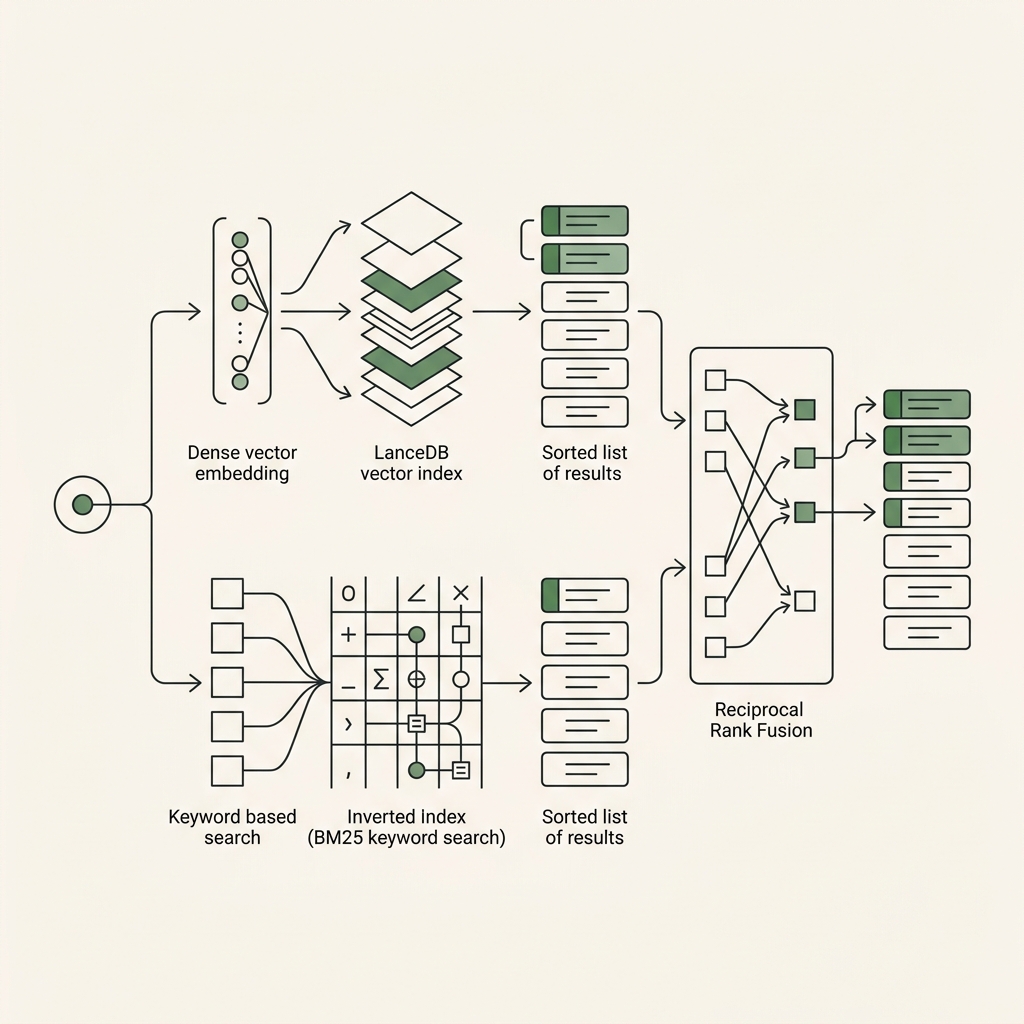
Technical Architecture
Hybrid RAG + Graph RAG
Blended vector-symbolic knowledge retrieval and network relationship traversal systems.
User & Researcher Perspective
Hybrid RAG + Graph RAG combines the strengths of deep semantic vector searches and exact word matches to retrieve qualitative research. By traversing a network graph connecting primary sources, extracted codes, nuggets, facts, and tasks, it provides highly cohesive summaries that reconcile divergent research inputs without losing context.
Operational Workflows & Intent
- Relationship Traversal: Researchers explore qualitative connections (e.g. how a specific task relates to a user complaint and an academic paper recommendation).
- Lossless Context Retrieval: Prevents semantic drift by combining vector queries with symbolic keyword lookups for specific terms, codes, or participant names.
Engineering & Architecture Perspective
RAG pipelines and vector embedding caches are managed in backend/app/core/embedding_cache.py and traversed via the research validity service in backend/app/services/research_validity_service.py.
Granular Technical Data Flow
- Indexing: Primary sources are split into semantic chunks, vectorized using local models, and indexed in LanceDB while simultaneously populated in a BM25 text index.
- Retrieval Querying: A user query triggers parallel similarity (vector) and term-frequency (BM25) queries.
- Reciprocal Rank Fusion (RRF): The query rankings are blended via Cormack's RRF algorithm to produce a consolidated list of highly relevant chunks.
- Graph Traversal: The system expands context by querying LanceDB relational links, retrieving all parent codes, task states, and related evidence nuggets.
Technical Documentation Approach
The RAG system enforces trace integrity: no synthesized assertion is reportable unless its active vector and graph paths can be traced back to accepted primary source spans.
Compliance & Quality Invariants
- Trace-back Enforcements: Every Graph RAG query must register its context-retrieval graph in the database to support full engineering audits.
- Strict Isolation: LanceDB partitions must enforce cryptographic scope boundaries to prevent cross-project context leaks.
Scientific Foundations & Bibliography
Our hybrid search system implements validated data retrieval and fusion techniques:
- Foundational RAG: Lewis et al. (2020) — "Retrieval-Augmented Generation for Knowledge-Intensive NLP Tasks" NeurIPS 2020.
- Graph-Augmented Summarization: Edge et al. (2024) — "From Local to Global: A Graph RAG Approach to Query-Focused Summarization" arXiv:2404.16130. Basis for relational network searches.
- Ranking Fusion (RRF): Cormack et al. (2009) — "Reciprocal rank fusion outperforms condorcet and individual rank learning methods" SIGIR 2009.
- Symbolic Search Baseline: Robertson & Zaragoza (2009) — "The Probabilistic Relevance Framework: BM25 and Beyond" Foundations and Trends in Information Retrieval 3(4).
Source Code Reference
backend/app/core/embedding_cache.pybackend/app/services/research_validity_service.py