Technical Architecture
Human-in-the-Loop Kanban
Governed task execution workspace and provisional human-in-the-loop review gates.
User & Researcher Perspective
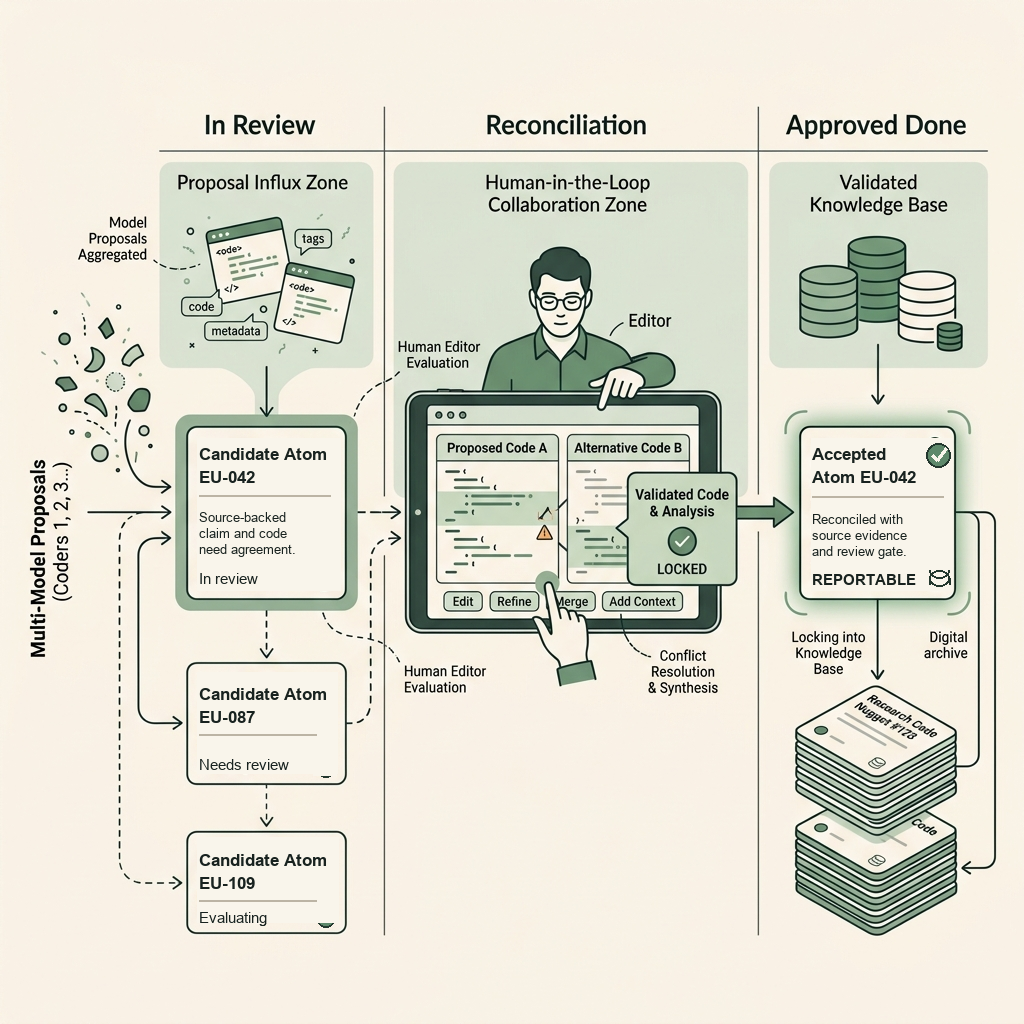
Human-in-the-Loop Kanban keeps the researcher in absolute control of all research outputs. While AI swarm agents autonomously process transcripts and tag codes in the background, all results are populated into a provisional 'In Review' queue. Nothing can be published or compiled into a final report without explicit human verification and sign-off.
Operational Workflows & Intent
- Reconciliation Board: Researchers drag, drop, merge, or refine proposed findings on a visual board.
- Done-Task Gates: Tasks are promoted to the 'Approved Done' state only after a researcher explicitly verifies and locks the source evidence links.
Engineering & Architecture Perspective
Task states are managed under the Meta-Hyperagent schema in backend/app/api/routes/meta_hyperagent.py and tracked via the runner in backend/app/core/agent_execution.py.
Granular Technical Data Flow
- Agent Execution: An agent completes a coding task and posts candidate findings to the database.
- Provisional Staging: The findings are registered with a `provisional=True` flag and rendered on the Kanban board under review lists.
- Human Adjudication: The researcher modifies, merges, or accepts the finding.
- Locking Constraint: The database updates the state to `approved=True` and locks the record against automated modifications.
Technical Documentation Approach
Our Human-in-the-Loop review queues follow the NIST AI Risk Management Framework to prevent agentic hallucination leakages and ensure human control.
Compliance & Quality Invariants
- Review Integrity: Reports compiler strictly filters out any nugget or finding that does not possess an active human-approval timestamp.
- Immutable Locks: Approved findings cannot be edited, deleted, or updated by autonomous agent threads.
Scientific Foundations & Bibliography
The review spine implements structured methodology concepts and risk frameworks:
- Atomic Research Methodology: Sharon & Gadbaw (2018) — "Atomic Research" WeWork Research Operations. Inspires our source-grounded evidence loops.
- AI Safety Governance: NIST (2023–2026) — "AI Risk Management Framework 1.0" and GenAI profile resources. Governs human-in-the-loop task boundaries and telemetry tracking.
Source Code Reference
backend/app/api/routes/meta_hyperagent.pybackend/app/core/agent_execution.py