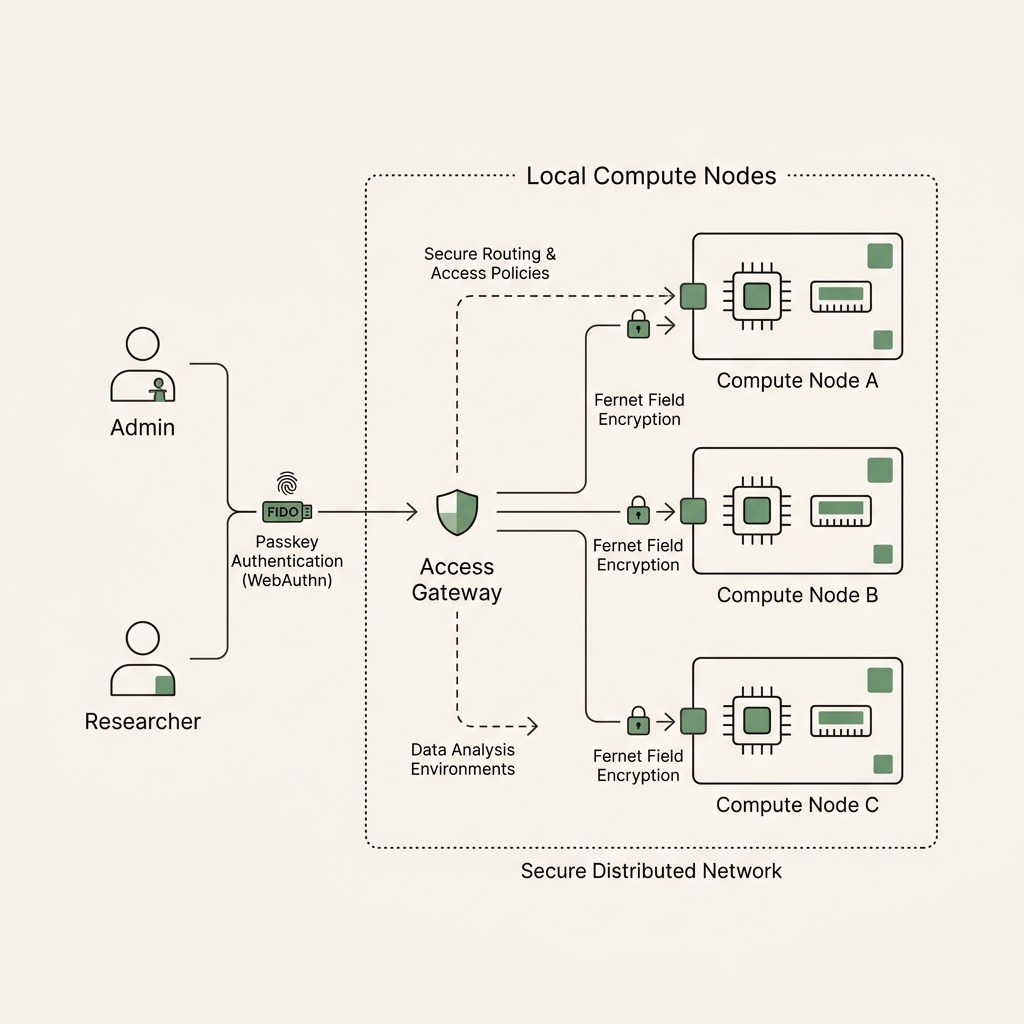
Technical Architecture
Distributed Compute & Roles
Multi-tenant role-based access security, cryptographic passkeys, and field encryption.
User & Researcher Perspective
Distributed Compute & Roles protects sensitive qualitative research through enterprise-grade cryptographic security. The system utilizes secure biometric passkeys (registered to your hardware keychain) to replace weak passwords, and enforces strict separation between researcher roles (managing coding and transcripts) and administrator roles (managing swarm connections and system diagnostics).
Operational Workflows & Intent
- Passwordless Passkeys: Simple, secure biometric authentication using TouchID/FaceID registered to your local keychain.
- Workspace Segregation: Scoped project interfaces isolate client data, preventing cross-tenant information disclosure.
Engineering & Architecture Perspective
Authentication and session validation are implemented in backend/app/api/routes/auth.py and scoped boundaries are enforced via backend/app/api/agent_project_scope.py.
Granular Technical Data Flow
- WebAuthn Challenge: The login flow requests a cryptographic challenge from
/api/auth/webauthn/challenge. - Hardware Verification: The browser registers or verifies the credential via the WebAuthn API, producing a signature verified using the server's registered public key.
- Token Guarding: Following authentication, a session token is issued and bound to the client's local IP and user-agent string.
- AES Scoping: Sensitive connection strings and external credentials are encrypted at rest using Fernet AES-128 keys.
Technical Documentation Approach
Our security design is modeled after the OWASP Application Security Verification Standard (ASVS) 5.0.0 and NIST Digital Identity guidelines, ensuring high protection for sensitive research details.
Compliance & Quality Invariants
- Base URL Validation: CORS policies explicitly drop websocket connections from mismatched origins.
- Administrative Separation: Admins cannot execute SQL or LanceDB mutations within active researcher project workspaces.
Scientific Foundations & Bibliography
Security architectures implement modern biometric standards and cryptographic guidelines:
- Identity Guidelines: NIST (2025) — "Digital Identity Guidelines, SP 800-63-4 and SP 800-63B-4". Outlines MFA, session, and authenticator standards.
- Hardware Passkeys (WebAuthn): W3C (2026) — "Web Authentication: An API for accessing Public Key Credentials, Level 3".
- Auth Architectures: Better Auth (2026) — "Security" Reference on origin validation, CSRF, and secret handling.
Source Code Reference
backend/app/api/routes/auth.pybackend/app/api/agent_project_scope.py