Core Swarm Capability
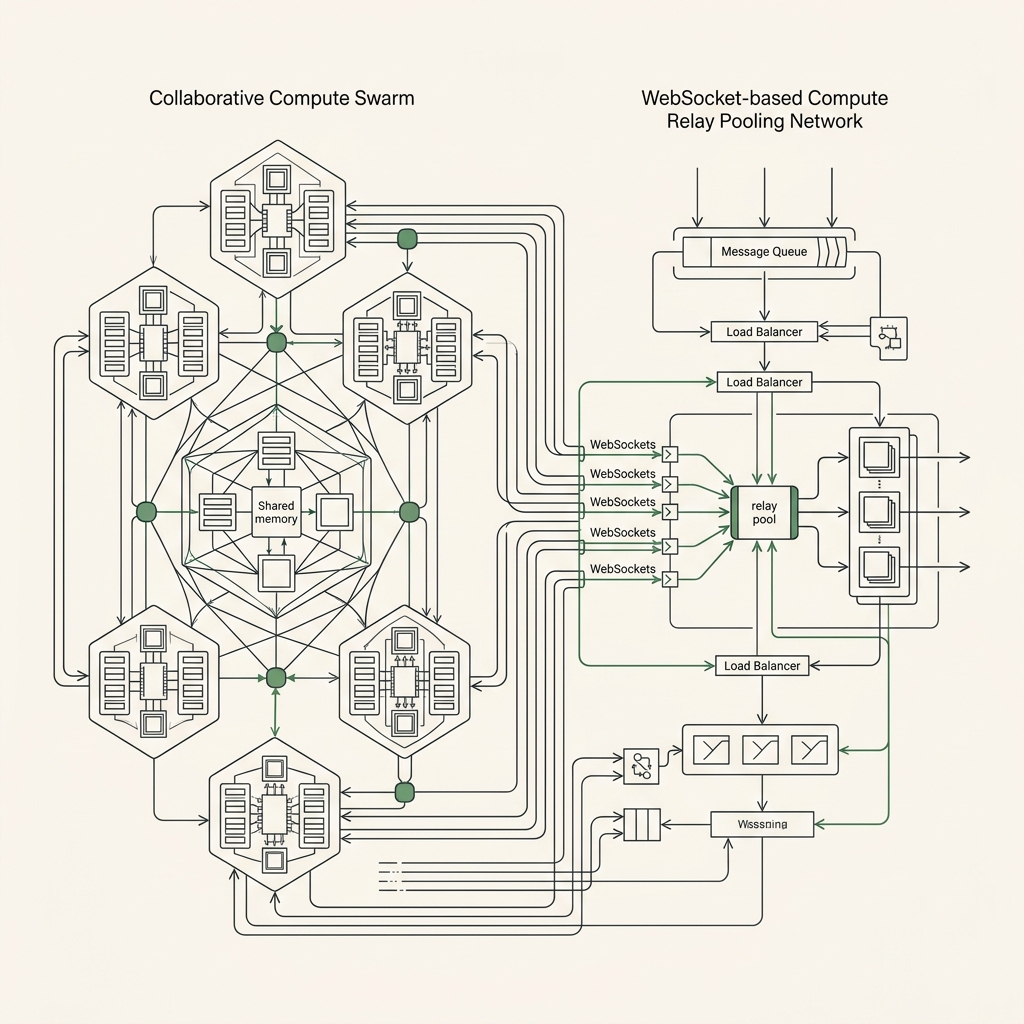
Collaborative Compute Swarm
Shared local model processing relays and WebSocket-based collaborative GPU/CPU pooling.
User & Researcher Perspective
Collaborative Compute Swarm allows teams to run heavyweight AI models locally by pooling their computers' GPU and CPU power. Instead of sending sensitive qualitative data to third-party cloud servers, researchers contribute their idle hardware resources via a secure network, enabling fast, zero-cost, offline qualitative analysis.
Operational Workflows & Intent
- Local Computing Pool: Researchers enable compute donation in their settings to contribute VRAM or CPU threads when idle.
- Swarm Model Routing: Heavy embedding or inference tasks are automatically routed to the fastest online donor in the office, eliminating individual hardware bottlenecks.
Engineering & Architecture Perspective
Inference distribution and WebSocket pooling are governed by backend/app/core/compute_registry_invocation.py and routed through the real-time events portal in backend/app/api/websocket.py.
Granular Technical Data Flow
- Connection Registration: Donor nodes authenticate and register their hardware profile (VRAM, compute cores, and supported models) over WebSocket.
- Task Queueing: An active RAG or coding task requests inference; the compute scheduler checks the online donor registry and selects the optimal node.
- Request Tunneling: The prompt payload is securely transmitted over the WebSocket connection to the designated donor node.
- Failover Recovery: If a donor node disconnects or times out mid-request, the scheduler automatically flags the failure and reroutes the request to a fallback node.
Technical Documentation Approach
Compute Swarm nodes communicate over encrypted connections. Task validation processes ensure that no model weights or user-provided prompt data can be permanently cached or disclosed on donor nodes.
Compliance & Quality Invariants
- Zero-Retention Policy: Nodes processing swarm inference must discard all processed prompt states immediately after sending results.
- Hardware Safeguards: Compute donation profiles are restricted under user-configured temperature and resource utilization limits.
Scientific Foundations & Bibliography
Distributed model inference is inspired by collaborative research networks and decentralized GPU pooling protocols:
- Collaborative Inference: Borzunov et al. (2022) — "Petals: Collaborative Inference and Fine-tuning of Large Models" arXiv:2209.01188. Explores peer-to-peer VRAM pooling.
- Internet-Scale Distribution: Borzunov et al. (2023) — "Distributed Inference and Fine-tuning of Large Language Models Over the Internet" NeurIPS 2023.
Source Code Reference
backend/app/core/compute_registry_invocation.pybackend/app/api/websocket.py